Archive for November, 2009

The Decade’s Best: No. 42 J.C. Holt

Monday, November 30th, 2009

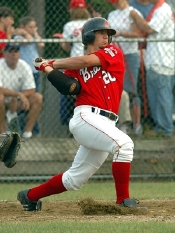
ph_448256.jpgJ.C. Holt
Brewster 2003
Outfielder
LSU

Few players — even the great ones — get their name mentioned every season. The years pass by. You remember those players, but they don’t necessarily have an anchor in the present.

J.C. Holt is the exception.

In 2003, Holt won the batting title with a .388 average. To that point, it was the highest average of the decade.

Six years later, it still is.

When Conor Gillaspie chased the batting title in 2007, we talked about Holt. It was the same thing in 2008, when Jimmy Cesario came as close as anybody has. Todd Cunningham hovered in the .400s for much of 2009 and again, Holt’s name popped up.

All because the little outfielder from LSU had himself one heck of a summer in 2003.

Holt came to the Cape after his sophomore season with the Tigers. He was a standout player, but there weren’t any numbers that predicted a record-setting summer. He had hit .349 as a freshman and .299 as a sophomore.

All summer, though, he just kept hitting. He played in 33 games for Brewster. He had at least one hit in 29 of those games. At one point, he put together a 20-game hitting streak, which ended on the last day of the regular season.

To make it all more impressive, 2003 wasn’t a particularly offensive year. The league hit .229. Holt was one of only seven players with a .300 average. By contrast, seven pitchers had sub-1.00 ERAs, which is almost unheard of.

Somehow, in that landscape, Holt delivered a season to remember. Despite having just one home run and only nine RBI, he was voted league MVP.

Then and now, I’d say he deserved it.

After the Cape

Holt followed up his summer by hitting .393 as a junior at LSU. He was picked in the third round of the 2004 draft by the Braves, and he remains in their system. He spent the 2009 season at Triple A Gwinnett, where he hit .282.
The Decade’s Best: No. 43 Buster Posey

Monday, November 30th, 2009

BusterPoseyYD2007.jpgBuster Posey
Yarmouth-Dennis 2006 & 2007
Shortstop/Catcher
Florida State

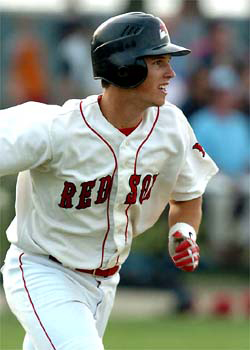
Buster Posey certainly deserves a mention if you’re discussing the best Cape League catchers of the decade.

One thing sets him apart: he was a pretty good shortstop, too.

Posey played two summers on the Cape, but from one year to the next, if you remembered him, you probably had to look at a lineup card to find him.

Posey came to Florida State as a shortstop. From day one, he was the starter and he started every game for the Seminoles, hitting .346 and earning a host of Freshman All-America honors. He looked like a star shortstop in waiting, and he more than held his own on the Cape. In helping Y-D to a championship, Posey hit .289 with 10 extra-base hits. He also pitched in four games and had an ERA of 3.12.

Then everything changed.

Before his sophomore season, Posey moved to catcher. Even as he learned the position, he didn’t miss a beat offensively. He still hit .382 for the Seminoles. When he returned to the Cape, he was a catcher through and through. Back with the Red Sox — and leading them to a second straight championship — Posey hit .281.

At the time, especially on that Y-D team, Posey wasn’t the superstar. The overall numbers from his two seasons on the Cape aren’t overwhelming, but he was a driving force on two championship teams. If you watched him, chances are you came away impressed.

And as you probably know, Posey’s Cape summers were just the beginning.

After the Cape

Posey was good in 2006 and 2007, but I don’t know if anybody could have predicted what he did in the spring of 2008, when he became arguably the best player in college baseball. He hit .463 with 26 home runs and 93 RBI.

If Posey was outside the upper echelon of draft prospects after the summer, he was crashing the party in the spring. By June, he was a candidate to go No. 1 overall. He ended up going fifth, but he’s made everyone who passed on him regret it. After dominating at every brief stop, Posey made his Major League debut for the Giants in 2009. He didn’t see a ton of action, but he remains one of the top prospects in the game.

The Decade’s Best: No. 44 Chris Young

Sunday, November 29th, 2009

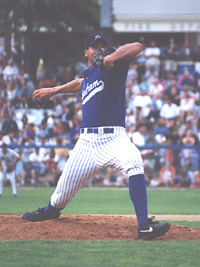
week_chrisyoung.jpgChris Young
Chatham 2000
Pitcher
Princeton

I once saw Chris Young and teammate Dan Krines eating a pre-game pizza at Carmine’s in Chatham. They were in uniform so they were hard to miss.

Young was a little harder to miss. I don’t know if there any records on this kind of thing, but there’s a decent chance that Young — who stands 6′10 — is the tallest player in Cape Cod Baseball League history. To this day, he’s one of the tallest people I’ve seen in day-to-day life, away from a basketball court. Seeing him sitting at a regular table like an average person would at a child’s plastic table is an image I still remember.

Of course, it helps that he made an impression on the field, too.

I don’t think he pitched that night I saw him — pre-start pizza probably isn’t the best idea — but I saw him other times. This was long before I started Right Field Fog, but I knew then that his was a name I wanted to file away and remember.

Not only was he big, he was very good.

Young pitched just the one summer for Chatham but he had as good a single season as just about anybody. In eight starts, he went 4-2 with a 1.86 ERA. Most impressively, he struck out 69 in 53.1 innings for a K/9 of 11.7.

At the time, Young was a two-sport standout at Princeton, but his Cape League performance helped push him in the baseball direction. He had been drafted before the Cape season, in June of 2000. After the season, he signed with the Pirates, who had picked him in the third round.

After the Cape

Young quickly became one of the top prospects in the Pirates system before he was traded to the Expos and then to the Rangers. He made his major-league debut with the Rangers in 2004. He has been a consistent No. 2/No. 3 starter since then, with his best years coming for the Padres in 2006 and 2007.

The Decade’s Best: No. 45 Marc Krauss

Sunday, November 29th, 2009

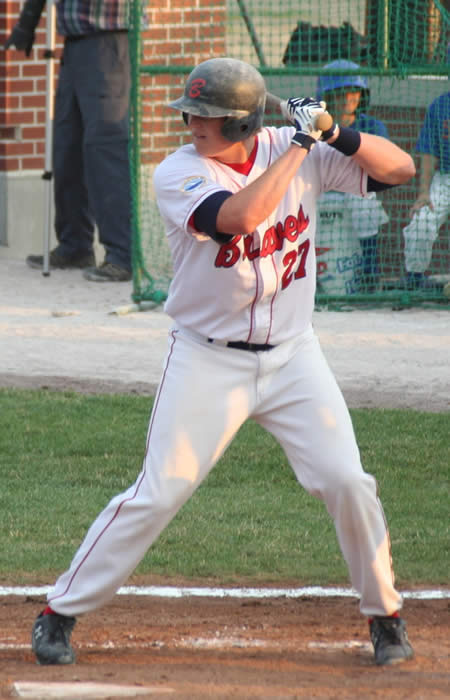
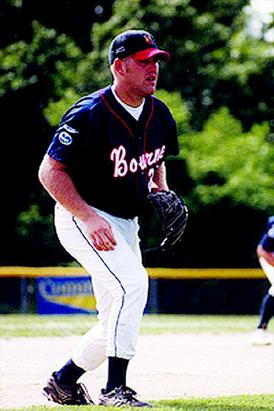
MarcKrauss-1.jpgMarc Krauss
Harwich/Bourne 2008
Outfield
Ohio University

There was a chance that Marc Krauss’ Cape League career could have ended after four games.

A star but still a relative unknown at Ohio University, Krauss was with the Harwich Mariners in June of 2008. After four games — in which he had three hits — the Mariners needed to make room for players that had already been signed. Krauss wasn’t one of them. He packed his bags.

Thankfully, he didn’t have to go very far.

The handling of releases like this is one of the great things the Cape League does. If a player leaves one team, another team that does have room can pick him up. It gives another chance to a player who deserves to be on the big stage.

In the case of Krauss, he took his chance and ran with it. The rest is history.

After hooking on with the Bourne Braves, Krauss put together an all-star season that would have been MVP-worthy in a lot of years. He hit .344 with 10 extra-base hits, three home runs and a league-best 34 RBI. He also led the league with a .473 on-base percentage. In the decade, that’s second only to Kevin Youkilis.

Those numbers hinted at what Krauss could become — a true professional hitter.

Thank goodness he got the chance.

After the Cape

Building on his successful summer, Krauss delivered a huge junior season at Ohio, hitting .402 with 27 homers, 70 RBI and an obscene .523 on-base percentage.

The Diamondbacks picked him in the second round of the 2009 draft and he didn’t disappoint in his debut, hitting .304 for the South Bend Silverhawks of the Midwest League.

The Decade’s Best: No. 46 Ryan Patterson

Wednesday, November 25th, 2009

AW_RyanPatterson.jpgRyan Patterson
Brewster 2003 & 2004
Outfielder
LSU

In 2003 and 2004, the Cape League’s best hitter was a Brewster Whitecap from LSU.

It wasn’t Ryan Patterson both times — that would have put him a little higher on this list — but Patterson still had himself a really solid Cape League career.

In 2003, while his Brewster and LSU teammate J.C. Holt won the Cape League batting title with a .388 average, Patterson hit .288 and led the Whitecaps in doubles with eight and RBI with 24. He also struck out just 19 times in 118 at-bats.

The next spring, in his junior year, Patterson emerged as a bona-fide star for LSU, hitting .341 and leading the team in homers, doubles and RBI.

He picked up where he left off in the summer of 2004.

Back with Brewster, Patterson won the batting title with a .327 average. He added six doubles, five home runs and 25 RBI. He finished third in the league in slugging percentage.

The race for the batting title came down to the season’s final day. Three players — Patterson, Jordan Brown and Pat Reilly — were within nine points going into the games of August 8. Patterson ended up going 1-for-4, Brown went 0-for-4 and Reilly went 2-for-4. Patterson’s average turned out to be five ten-thousandths of a point better than Reilly’s.

After the Cape

After hitting 20 homers for LSU in 2005 and earning a host of All-America nods, Patterson was drafted in the fourth round by the Toronto Blue Jays. He played four seasons in the Blue Jays’ system before he was released after spring training in 2009. He signed on with the independent Fort Worth Cats and hit .284 with 12 home runs and 27 doubles.

The Decade’s Best: No. 47 Kevin Youkilis

Tuesday, November 24th, 2009

KevinYoukilis.jpgKevin Youkilis
Bourne 2000
Third Baseman
Cincinnati

In his bestselling book Moneyball, Michael Lewis tells of Oakland’s fascination with Kevin Youkilis, then a minor-leaguer in the Red Sox system. Members of the A’s front office dubbed him “The Greek God of Walks.”

He fit their style perfectly. Every step of the way, he’d shown a remarkable amount of plate discipline and an uncanny ability to get on base.

Every step of the way.

After his junior year at Cincinnati, Youkilis headed to Bourne, where he did his thing for the Braves. He hit .309 with 11 extra-base hits, three home runs and 14 RBI. Most notably, he led the league with 40 walks and a .488 on-base percentage. That mark still stands as the best on-base percentage of the decade.

Is it any wonder Youkilis is the one holding that record?

Youkilis’ summer didn’t vault him immediately into upper-echelon status. But after he went undrafted after his junior year, Youkilis’ performance on the Cape and his big senior season paved the way for the Red Sox to pick him in the eighth round in 2001.

After the Cape

I feel like you probably know. Youkilis has become one of the most successful alums of the decade.

After ascending through the Red Sox system, Youkilis grabbed a starting spot in 2007 and he hasn’t let go. He had his best season in 2008, when he hit .312 with 29 home runs and 115 RBI.

The Decade’s Best: No. 48 Brad Lincoln

Monday, November 23rd, 2009

BradLincoln.jpgBrad Lincoln
Bourne 2005
Pitcher/DH
Houston

Every spring, there’ll be a handful of college players who shine at the plate and on the mound. But when summer rolls around, those guys usually focus on one thing, especially on the Cape.

Brad Lincoln was the exception.

One of the few two-way regulars, Lincoln gets a nod here not just because he did both, but because he did both well.

Playing for a Bourne team that lost in the championship series, Lincoln made nine starts on the mound and saw action in 39 of 44 games as a hitter. He was one of the league’s busiest players in 2005, and also one of the best.

As a hitter, he batted .243, but made up for that low average with 12 extra-base hits, six home runs and 25 RBI.

He shined a little brighter with the ball in his hand. In his nine starts, he went 3-1 with a 1.32 ERA, putting himself in the same company as standout contemporaries Tim Norton, Andrew Miller and Daniel Bard. He struck out 56 and walked only 10 in 54.2 innings. He was also honored with the 10th Player Award.

His performances on the mound garnered the most attention. Baseball America rated as the league’s best prospect, noting that his 90-95 mph fastball and his power curveball sent him on a track toward a pitching future.

After the Cape

The Pirates made Lincoln the fourth overall pick in the 2006 draft. He was one of seven Cape Leaguers to go in the top 10 picks.

In April of 2007, Lincoln needed Tommy John surgery, but he returned last year and he has been healthy since.

All the way along, he has been ranked among the top four prospects in the Pirates system every year. In the 2009 season, he posted a 2.28 ERA in Double A before getting a promotion to Triple A Indianapolis, where he had a 4.70 ERA.

He was recently added to the Pirates’ 40-man roster.

The Decade’s Best: No. 49 Derrik Lutz

Monday, November 23rd, 2009

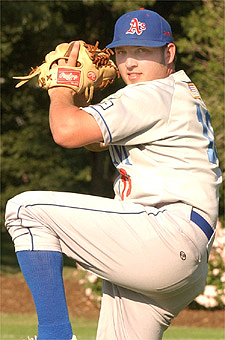
Wk4_DerrickLutz.jpgDerrik Lutz
Chatham 2005 & 2006
Pitcher
George Washington

For whatever reason, Chatham has been home to some dominant closers over the years, but few had as good a season as Derrik Lutz did in 2005.

On a team stacked with fireballers, power hitters and future pros — one of the more talented teams of the decade — Lutz emerged as one of the key pieces of the puzzle, despite the fact that he came from an A-10 school and didn’t have the typical pitcher’s frame. But after working as a starter at George Washington in 2005, Lutz slid into the closer’s role for the A’s and was absolutely lights-out.

He tied for the league lead with 12 saves and he didn’t allow a single run — earned or unearned — in the regular season. In 25 innings of work, he struck out 39, walked only three and allowed just 13 hits. Do a little math and you realize that’s a WHIP of 0.64. It doesn’t get much better than that.

After another strong spring with George Washington in 2006, Lutz was drafted in the 19th round by the Reds. He opted to make the trip to the Cape and pitched in six games before signing. He allowed one run in those six appearances, bringing his career regular-season ERA to 0.28.

After the Cape

Lutz has climbed slowly but surely through the Reds system and 2009 saw him put up his best numbers yet. Working out of the pen for Double A Carolina, Lutz had a 1.99 ERA and 17 strikeouts in 22.2 innings.

Cotuit Roster

Sunday, November 22nd, 2009

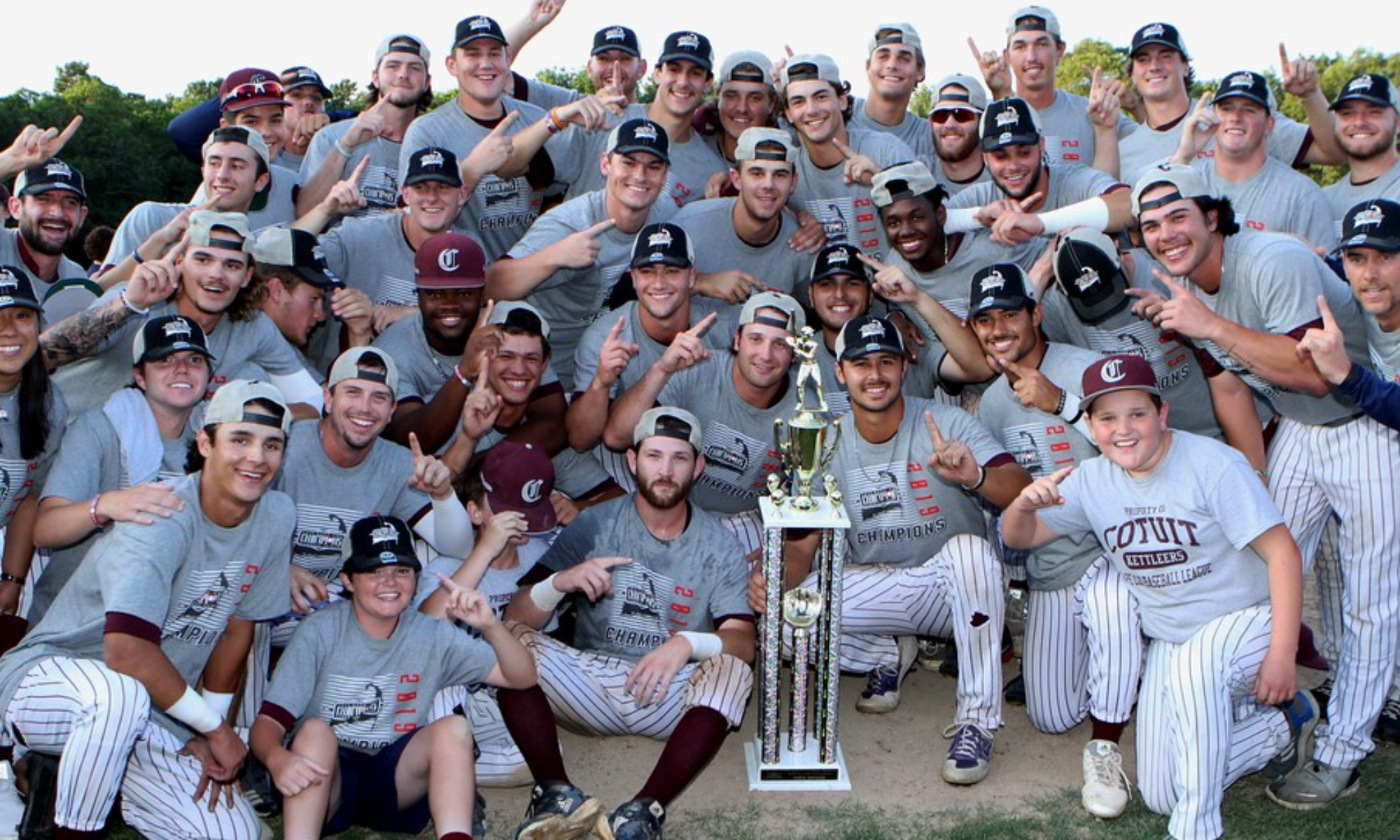
Cotuit became the third team to release its 2010 roster. There are 23 players so far. The headliner is Arkansas’ Zack Cox, though he’s draft-eligible sophomore, so he may not make it back for a second summer in Cotuit.

Just two returning players, at this point:

Zack Cox – 3B – Sophomore – Arkansas
Zach Cone – OF – Sophomore – Georgia

Cox was picked by Baseball America as the second-best prospect in the league last summer. If he somehow makes it back, he’ll be one of the more proven highly-touted players to return in a few years.

Cone was 12th on the same list. A third-round pick out of high school, Cone hit .243 for the Kettleers in 2009.

As for the rest, some impressions:

  • Konstantine Diamaduros is an easy name to notice. Between that and the numbers he put up last summer, his name is one I remembered immediately. Diamaduros, a lefty-swinging sophomore from Wofford College in South Carolina, tore up the Coastal Plain League in 2009. He led the league with a .376 average and added four home runs, 19 extra-base hits and 45 RBI. Diamaduros hit .299 last season for Wofford. He was originally a Clemson signee.
  • I love the fact that Oklahoma freshman Chad Kettler is going to be playing for the Cotuit Kettleers. It’s perfect. Kettler was a 24th-round pick out of high school.
  • Freshmen represented some of the biggest names on the Cotuit roster this time last year, but there aren’t quite as many this year. Kettler is one of just four. The other other three are Arizona State’s Deven Marrero and Brady Rodgers and Vanderbilt’s Michael Yastrzemski.
  • Yes, that Yastrzemski family. Mike is Carl’s grandson.
  • Among those four freshmen, Marrero might be the best. He was a 17th-round pick and is expected to compete for the starting shortstop job immediately in Tempe.
  • Two players who were on Cotuit’s early roster last year but didn’t make it are back on there this year. Jonathan Taylor made a big splash early for Georgia and ended up hitting .309. Vanderbilt’s Sonny Gray had a strong freshman campaign and spent the summer with Team USA.
  • Kentucky’s Chad Wright hit .343 last season, second on the Wildcats to ‘09 Kettleer Chris Bisson.
  • Michael Schum was a dynamic closer for Wright State last season. He finished with 13 saves, a 1.95 ERA and 57 strikeouts in 74 innings.
  • Kent State’s Andrew Chafin will be an interesting player to watch. He had a tremendous freshman season as a closer and was invited to Team USA, but he had Tommy John Surgery in June. He is working his way back but may redshirt this season. Next summer could represent his return.
  • The Citadel’s Drew Mahaffey had really good numbers as a closer last season, striking out 71 in 50 innings.
  • Cotuit had good luck with a junior college pitcher last summer — Chad Bell — and will hope for good things from San Jacinto’s David Rollins in 2010. Rollins struck out 69 in 66 innings last spring.
  • Let’s Do a List

    Sunday, November 22nd, 2009

    The post below is the beginning of a series looking back on the best Cape League players of the decade.

    I had the idea awhile ago and once I confirmed that this is in fact the last year of the decade, I set out working on it. It was all ready to go about two weeks ago, until I realized I had left two players out who clearly should have been on the list. This shot holes through the whole thing, so I kind of started over. Without a lot of spare time, I wasn’t able to get it done as quickly as I hoped, but it’s finally ready. Since there are fewer than 50 days before the end of the decade, I’ll do two per day a few times to catch up. At the end, I’m planning on picking a team and franchise of the decade, as well.

    A few notes on the list:

  • At some point, it turned into splitting hairs, especially among the pitchers. In a Cape League sample size, there isn’t much difference between a 0.50 and 1.50 ERA, so it was a little tough to make distinctions. There were 20 more pitchers who you could make a pretty good case for. It’s all in fun, though, so I’m not too worried about it.
  • Stats were the biggest factor, but I gave some weight to subjective stuff, too. Two big factors: how a player was thought of in his season and how a player performed relative to his peers. For instance, Evan Longoria put up huge offensive numbers in the best pitching year of the decade. I tried to take stuff like that into account where I could.
  • The year 2005 was ridiculous. You’ll see.
  • The debate for the top spot came down to two players, and it was really hard to separate them. The suspense must be killing you.
  • So that should sum it up. We’ll have at least one every day until the New Year. Feel free to comment on the posts and share your memories of these guys. More than rankings, that’s what this thing is all about.