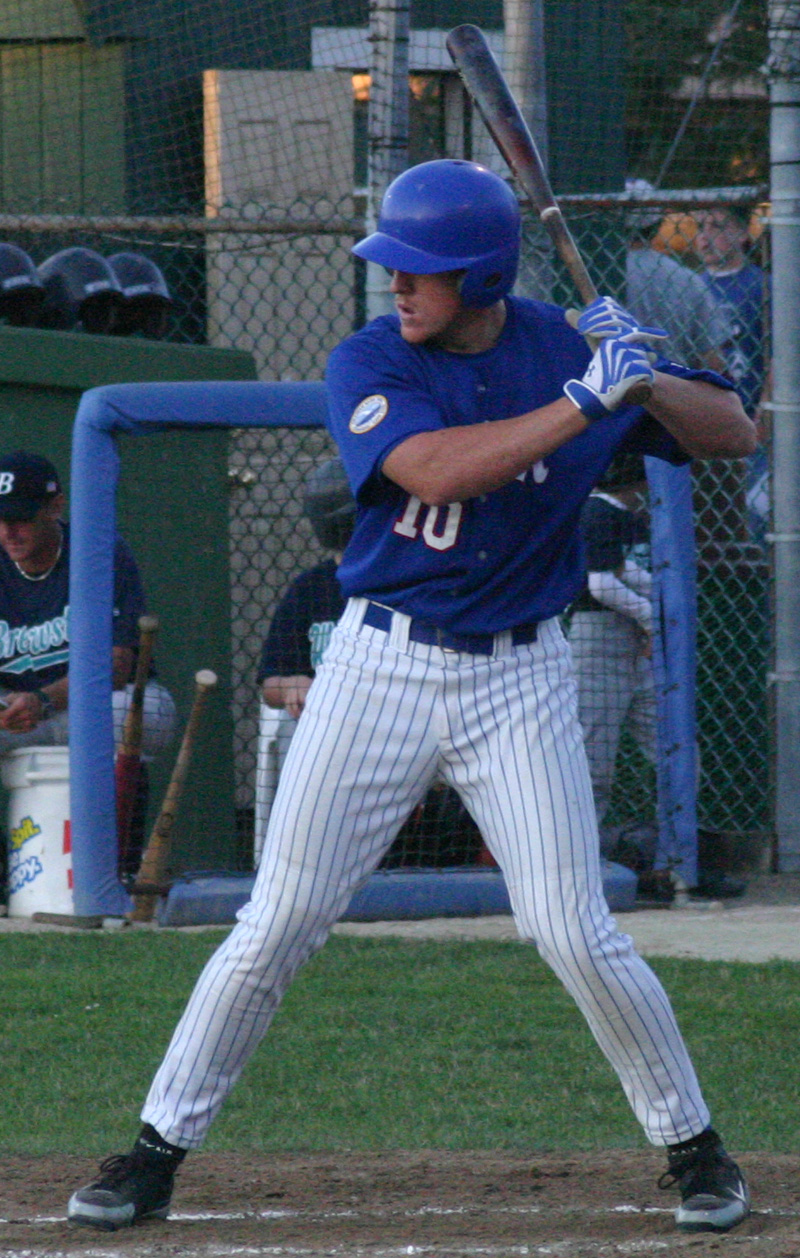
The Decade’s Best: No. 37 Allan Dykstra

IMG_9098.JPGAllan Dykstra
Chatham 2006 & 2007
First Baseman
Wake Forest

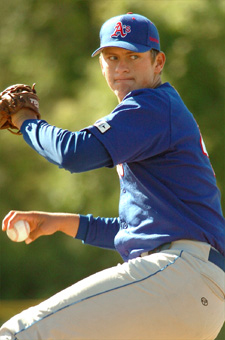
The decade’s best run producer wasn’t Justin Smoak or Evan Longoria or Gordon Beckham. Those guys may have gotten all the headlines, but the guy driving in all the runs? That was Allan Dykstra.

Of course, the big first baseman from Wake Forest spent two summers in Chatham, which paved the way. But he still had to do the driving — and the driving in.

He did a lot of it.

In 82 career games, Dykstra drove in 60 runs. There are plenty of other guys who spent two summers on the Cape and drove in a lot of runs, but no one this decade drove in as many as Dykstra.

After his freshman year at Wake, he immediately became a mainstay in the middle of Chatham’s order. That first summer, he only batted .232, but he still managed seven home runs, and he led the league with 29 RBI.

The next year, Dykstra got off to similar start — not a ton of hits, but a lot of big hits — until he caught fire in the midway point of the season. He ended up as one of the best hitters in a class that was stacked with them. He hit. 308 with five home runs and 31 RBI.

With some big hitters in the league that same year, Dykstra finished third in RBI in 2007. It would have been pretty cool if he had won two RBI titles, but that doesn’t take anything away from the numbers.

If a Chatham run was scoring in 2006 and 2007, there was a good chance Dykstra was knocking it in.

After the Cape

Dykstra was picked by the Padres with the 23rd overall pick in 2008. In 2009, his first full season, he hit .226 with 11 home runs and 60 RBI.
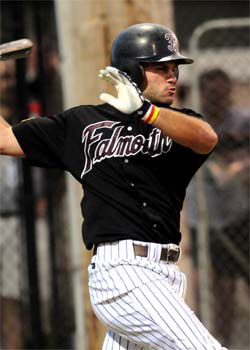
The Decade’s Best: No. 38 Jimmy Cesario

PP5_JimmyCesario.jpgJimmy Cesario
Falmouth 2008
Outfielder/Infielder
Houston

Jimmy Cesario didn’t stay on the Cape quite as long as everyone in Falmouth would have hoped. He signed a pro contract with the Rockies soon after the All-Star game.

But in the 34 games he played in before he left, Cesario made his stay worthwhile.

Much like J.C. Holt, Cesario got hot at the beginning of the summer and never really cooled down. His league-best .387 average was one point off Holt’s decade-best average.

Cesario is a little higher on this list because he delivered some amazing run production for a guy who wasn’t flashing a whole lot of power. He had one home run, eight doubles and one triple, but finished the season with 30 RBI, which ranked fourth in the league.

Cesario put up those numbers despite a situation that could have left him unsettled. He’d been drafted in June but not until the 46th round. He hooked on with Falmouth to try and enhance his stock. Once there, he bounced around the batting order and the field, playing 17 games in the outfield, 14 games at second base and two at first.

Through it all, Cesario just kept hitting and kept driving in runs. His 30 RBI were the most by a batting champ in the decade.

After the Cape

By the team the season was over and awards were getting handed out, Cesario was already a professional. He hit .333 in 22 games with Casper of the Rookie Pioneer League. He spent 2009 with the Asheville Tourists of the South Atlantic League, batting .285 with 11 home runs.

The Decade’s Best: No. 39 Jared Hughes

Wk2_JaredHughes.jpgJared Hughes
Chatham 2005
Pitcher
Long Beach State

Jared Hughes came to Chatham with his Long Beach State teammate Evan Longoria. Both of them had breakout summers and both of them had a big hand in getting Chatham its highest win total of the decade.

While Longoria, being an everyday player, had an impact on a few more games, Hughes contributed as much as he possibly could.

Literally.

In the regular season, the towering righty made seven starts. He won all of them. And I don’t mean the A’s won all his starts. He got credited with a win in each of them.

In the Cape League’s statistical landscape, that’s exceedingly rare.

Hughes is one of only three players in the decade to win seven games. Six is generally the high-water mark. Among the three who did get to seven, Hughes is the only one who went undefeated.

At least in this decade, Hughes stands alone.

While the victories speak for themselves — and say more than enough — they aren’t the only reason Hughes is on this list. As you might expect for a guy who went 7-0, his other numbers were also outstanding. He finished the regular season with a 1.62 ERA and he struck out 54 in 50 innings, with just 11 walks. His best start came early in the summer, when he struck out 12 and didn’t walk anybody in a complete-game win over Falmouth.

After the Cape

Hughes was rated as the 18th best prospect in the league by Baseball America and he was drafted the next year in the fourth round. In four minor-league seasons so far, Hughes has compiled a career ERA of 4.55. Though he went 1-6 this year in Double A, he had a 3.88 ERA.

The Decade’s Best: No. 40 Dennis Raben

1476574.jpegDennis Raben
Orleans 2007
Outfielder
Miami

In retrospect, I think Dennis Raben sometimes got lost in the shuffle. His was a summer of stars like Gordon Beckham, Yonder Alonso, Conor Gillaspie and Aaron Crow. Raben belongs right alongside them.

In terms of production, there are only a handful of players on this list who had a better summer than Raben did.

He came to Orleans without a ton of fanfare. He hit .280 as a sophomore at Miami with 12 home runs. Good numbers but not spectacular. Once he put on a Cardinals uniform, though, he turned himself into one of the league’s biggest power threat, and in the process, turned himself into a major prospect.

For the season, Raben batted .298 with six home runs, 18 extra-base hits and 35 RBI. He tied Beckham for the league lead in RBI and was among the top five in three other offensive categories — slugging percentage, extra-base hits and runs scored.

He may have made his biggest splash in a game that didn’t count. A starter for the East squad in the all-star game, Raben blasted a home run that ultimately proved to be the difference in the East’s 3-2 victory. Raben was named East MVP.

After the season, Raben was tabbed by Baseball America as the seventh-best prospect in the league.

After the Cape

While players like Beckham and Buster Posey built on their summers with enormous junior season, Raben didn’t deliver an overwhelming performance when he got back to Miami. He still had solid numbers, though, and got picked in the second round by the Mariners. He hit .275 in his debut season but missed all of 2009 after knee surgery. He is expected to be ready for spring training in 2010.

The Decade’s Best: No. 41 Chris Dominguez

ChrisDominquez.jpgChris Dominguez
Harwich 2007 & Hyannis 2008
Third Baseman
Louisville

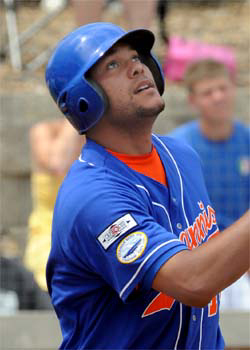
We’ve seen more talented and more well-rounded prospects than Chris Dominguez.

But on one night, with three swings of the bat, Dominguez put himself into exclusive company.

It was July 9, 2008. McKeon Park in Hyannis. A Wednesday. Dominguez was in the midst of an up-and-down start to his summer. He had been drafted in the fifth round in June. He was trying to prove himself.

On that night, he delivered the best single-game performance of the summer and one of the best of the decade. Dominguez belted three mammoth home runs, tying a Cape League record. The last guy to do it before Dominguez? Frank Thomas.

That’s pretty good company, and in terms of pure power, Dominguez belonged.

He was all-or-nothing at times. Playing for Harwich in 2007, he hit just .216 He struck out 38 times in 97 at-bats. The next spring, though, he was outstanding and he carried that into the summer. He still wasn’t the most balanced player and he struck out a lot, but he also hit .262 for the Mets in 2008. He led the league with 10 home runs and 22 extra-base hits. He finished third in slugging percentage and RBI.

For his Cape League career, Dominguez totaled 13 home runs and 30 extra-base hits.

Add in his one historic night, and you’ve got a player who we’re going to remember.

After the Cape

On the heels of his strong summer in 2008, Dominguez opted not to sign. He returned to Louisville, hit 25 home runs and repeated as the Big East Player of the Year.

In 2009, he was drafted in the third round by the Giants. He spent most of his first pro season in Low-A, where he hit .254 with nine home runs in 181 at-bats.